Writing
Freak Inheritance: Eugenics and Extraordinary Bodies in
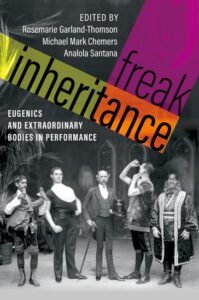
Performance. Edited by Rosemarie Garland-Thomson, Michael Mark Chemers, and Analola Santana. Oxford University Press.
The long-awaited follow-up to Garland-Thomson’s field-defining book Freakery, Freak Inheritance illuminates the convergence of the freak show era with the eugenics era, explicating the cultural work of the freak show as a compelling range of performances of cultural and social Others that emerge as eugenic targets from the late 19th century into the 20th century and beyond.
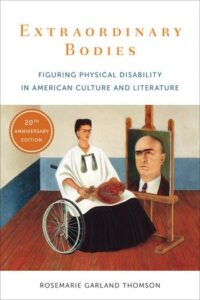
Extraordinary Bodies: Figuring Physical Disability in American Culture and Literature. 20th Anniversary Edition, with a new foreword by the author. Columbia University Press.
As the first major critical study to examine literary and cultural representations of physical disability, Extraordinary Bodies inaugurated a new field of disability studies in the humanities in 1996 by framing disability as a minority discourse, rather than a medical one, ultimately revising oppressive narratives of disability and revealing liberatory ones.
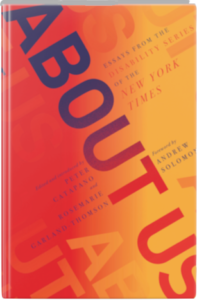
About Us: Essays from the Disability Series of the New York Times. Edited with Peter Catapano. Norton/Liveright.
Boldly claiming a space in which people with disabilities can be seen and heard as they are―not as others perceive them―About Us captures the voices of a community that has for too long been stereotyped and misrepresented. Speaking not only to those with disabilities, but also to their families, coworkers and support networks, the authors in About Us offer intimate stories of how they navigate a world not built for them.
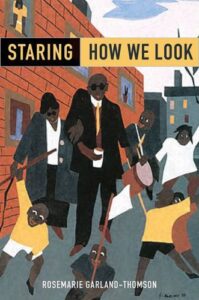
Staring: How We Look. Oxford University Press.
Garland-Thomson defines staring, explores the factors that motivate it, and considers the targets and the effects of the stare. Featuring over forty illustrations, Staring captures the stimulating combination of symbolic, material and emotional factors that make staring so irresistible while endeavoring to shift the usual response to staring, shame, into an engaged self-consideration. This unique study advances new ways of thinking about visuality and the body, appealing to readers interested in the overlap between the humanities and human behaviors.
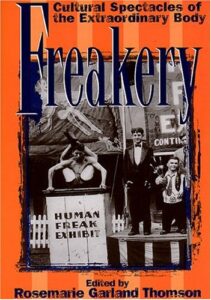
Freakery: Cultural Spectacles of the Extraordinary Body. NYU Press.
Freakery traces the freak show from antiquity to the modern period and explores the constitutive, political, and textual properties of such exhibits. Rosemarie Thomson’s groundbreaking anthology probes America’s disposition toward the visually different. Essays address such diverse topics as American colonialism and public presentations of natives; laughing gas demonstrations in the 1840’s; Shirley Temple and Tom Thumb; Todd Browning’s landmark movie Freaks; bodybuilders as postmodern freaks; freaks in Star Trek; Michael Jackson’s identification with the Elephant Man; and the modern talk show as a reconfiguration of the freak show.
“The Body She Had.” Article in Plough. (PDF)
“‘Enhancing’ future generations with CRISPR is a road to a ‘new eugenics’” book excerpt by Rosemarie Garland-Thomson framed for Live Science (with contributions from Nicoletta Lanese).
“The Dark Side of CRISPR” Op-ed for Scientific American (with Sandy Sufian).
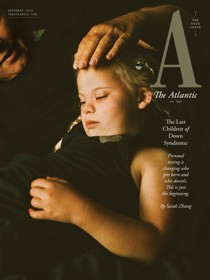
Contribution to “The Last Children of Down Syndrome” by Sarah Zhang. The Atlantic. The article presents a complex and sophisticated understanding of the ethical issues in relation to disability and reproduction, covering Down Syndrome testing, selection, and termination in Denmark.
Contribution to “What Strength Really Means When You’re Sick” by Ed Yong. The Atlantic.
Featured in “Disability and Higher Education: Inclusivity in an Increasingly Technologically Inclined Academic World.” From the United Nations Academic Impact program’s disability and higher education interview series.
“From Medical Condition to Political Condition: The Story of the ADA” in the Los Angeles Review of Books.
“My ‘Orphan Disease’ Has Given Me a New Family” in The New York Times.
“Becoming Disabled” in the New York Times Sunday Review.
Contribution to “Zika Virus Threat Puts Abortion Rights And Disability Rights On Collision Course” by Chloe Angyal in The Huffington Post.
“Siri and Me.” Op-ed for The Huffington Post.
“Elegy for Oscar Pistorius,” Op-ed for Al Jazeera.
“Hot Sex and Disability at the Movies.” Op-ed for The Huffington Post.
“Sex Lessons.” Op-ed for The Huffington Post.
“Language of Autocorrect,” Letter to the editor of The New York Times.
“What Misfitting Makes.” Article in Puncta: Journal of Critical Phenomenology (2024). (PDF)
“Putting a Face on WET Recipients.” Article in The American Journal of Bioethics (2024).
“A Disability Critique of the Comparative View.” Open Peer Commentary in The American Journal of Bioethics written with Rebecca Mueller, Amber Knight, and Sandy Sufian (2024).
“Narrative Equity in Genomic Screening at the Population Level.” Open Peer Commentary in The American Journal of Bioethics written with S.A. Larson (2023).
“When Anti-Discrimination Discriminates.” Article with Harold Braswell in The American Journal of Bioethics (2023). (PDF)
“Rethinking Fetal Personhood in Conceptualizing Roe.” Open Peer Commentary in The American Journal of Bioethics, written with Joel Michael Reynolds (2022).
“Evaluating the Lives of Others.” Article in The American Journal of Bioethics (2022).
“Encountering Disability Through Wonder,” Special Issue of Perspectives in Biology and Medicine edited by Rosemarie Garland-Thomson and Devan Stahl. (PDF of Table of Contents)
“How We Got to CRISPR: Reflections on the Dilemma of Being Human.” Perspectives in Biology and Medicine.
Co-author of “Disability Rights as a Necessary Framework for Crisis Standards of Care and the Future of Health Care.” The Hastings Center Report.
“Human Biodiversity Conservation: A Consensual Ethical Principle.” Article in The American Journal of Bioethics (2015).
“Disability Liberation Theology.” In The Oxford Handbook of Philosophy and Disability, eds. A. Cureton and D. Wasserman.
“Welcoming the Unexpected.” In Human Flourishing in an Age of Gene Editing. Oxford University Press.
“Disability Bioethics: From Theory to Practice.” The Kennedy Institute of Ethics Journal.
“Human Biodiversity Conservation: A Consensual Ethical Principle.” American Journal of Bioethics.
“What Do Unusual Faces Teach Us About the Ethics of Recognition?” AMA Journal of Ethics.
“Misfits: A Feminist Materialist Disability Concept.” Hypatia.
“Integrating Disability, Transforming Feminist Theory.” NWSA Journal.
Speaking
“The Moral Work of a Beautiful Story.” Distinguished lecture at the University of Virginia’s IHGC Personhoods Lab, sponsored by UVA’s Institute of the Humanities & Global Cultures.
“Changing the Story: Narrative Ethics Meets Disability Bioethics.” Speaker at Georgetown University’s Program in Disability Studies lecture on disability bioethics and reproductive ethics.
“Monstrosities and Metamorphosis in More-Than-Human Worlds.” Speaker at Oxford Kafka24 – Talk Series on Kafka and Disability (presented by University of Oxford’s Bodleian Libraries).
“Extraordinary Bodies, Disability Justice, and Metamorphosis.” Speaker at Oxford Kafka24 – Talk Series on Kafka and Disability (presented by University of Oxford’s Bodleian Libraries).
“Keynote: Time Traveling with Gregor Samsa, or what you can do with six legs.” Keynote Speaker at Oxford Kafka24 – Talk Series on Kafka and Disability (presented by University of Oxford’s Bodleian Libraries).
“CRISPR, Gene Editing, and Metamorphosis.” Speaker at Oxford Kafka24 – Talk Series on Kafka and Disability (presented by University of Oxford’s Bodleian Libraries).
“Disability Bioethics: a Path to Realizing Equality.” Presentation in the series “Stories for Survivability: How We Talk about Disability Ethics and Why It Matters” at the UNC Charlotte Center for Professional and Applied Ethics.
Invited speaker at the Bard College Philosophy Salon.
“Biomedical Ethics and the Existential Threat to Persons with Disabilities.” Lecture and discussion for Columbia University’s Department of Medicine and the Center for Clinical Medical Ethics, hosted by Dr. Lydia Dugdale, director of the Center for Clinical Medical Ethics.
“CRISPR and Human Identity: Governing Germline Gene Editing.” Plenary speaker at ELSI Virtual Forum, an International ELSI Congress event 30 Years of the Genome: Integrating and Applying ELSI Research at Columbia University.
Event co-organizer for “The Art of Flourishing: Conversations on Disability.” This National Endowment for the Humanities-funded public conversation series at the Hastings Center consists of six public events from 2019 to 2021 that explore how technologies can be used to promote or thwart meaningful, flourishing lives.
Event co-organizer and panel moderator for a public discussion with Rachel Kolb, Haben Girma, and Teresa Blankmeyer Burke, Baruch Performing Arts Center, New York City; part of the Hastings Center and National Endowment for the Humanities event series for “Shaping Humans: A Discussion Series on Technology, Disability, and Human Flourishing.”
Presentation at symposium and workshop on “Public Participation in Human Germline Editing Governance,” UC Berkeley, Berkeley, CA.
Talkback and public interview with playwright Stephen Unwin following performance of All Our Children play on Nazi histories of eugenics, The Sheen Center for Thought & Culture, New York, NY.
Panel discussion following screening of the film GATTACA, Center for Genetics and Society, Berkeley, CA.
Panel presentation on societal concerns for end of life care, End of Life Option Act Task Force Convening, Coalition for Compassionate Care of California, Sacramento, CA.
“Genome Surgery: CRISPR Cures, Community Perceptions and Questions of Equity,” Panel Participant at CRISPRcon: Science, Society, and the Future of Gene Editing, Berkeley, CA.
“Exploring Disability as an Identity with Professor Rosemarie Garland-Thomson” Interviewed for The Phi Beta Kappa Society’s Key Conversations with PBK series on her role as a pioneer in the field of disability studies and bioethics.
“imagining technologies for Disability futures (itDf)” Contributor to the itDf disability and culture symposium funded by the Wellcome Trust. Full traditional film available on YouTube as well as an Audio Described version.
“A Life Worth Living?” Featured in a Substack article by Amy Julia Becker on societal decisions about who decides who has a life worth living. Links to interviews and other media on the article.
“In Iceland, almost all diagnosed Down syndrome pregnancies are aborted after prenatal testing.” Interviewed for an Australian Broadcasting Corporation (ABC) article on eugenics, Down syndrome, and bioethics written by Anna Levy.
“What the Rise of the Tradwife Aesthetic Says About Beauty Trends.” Interviewed for a PopSugar article on beauty trends and aesthetic written by Ariel Baker.
“John Fetterman survived a Stroke. It could be an asset if he’s elected.” Interviewed for a Vox article on John Fetterman written by Karen Landman.
“‘Don’t have to hide’: For disability advocates, the spotlight on Fetterman’s recovery is a good thing.” Interviewed for a National Journal article on John Fetterman written by Savannah Behrmann and Erin Durkin.
“How can we live an ethical life?” Participated in Nuala McGovern’s BBC World Service interview with Australian philosopher Peter Singer.
“Humanity’s Awesome, Terrifying Takeover of Evolution.” Cited by Ezra Klein and Walter Isaacson in The Ezra Klein Show podcast.
“Difference or Disability?” Interview with Laura Hercher, The Beagle Has Landed podcast.
“Disability and Bioethics.” Radio broadcast with Paul Barclay, Australian Broadcasting Corporation.
“Inclusive Design.” Interview filmed for Microsoft’s Inclusive Design Toolkit.
“Sex with Disabilities.” Interview for HuffPostLive.
Interview with K.P. Whaley for The Kathleen Dunn Show, Wisconsin Public Radio.
Interview with Kirby Kochanoski for “Examining Disability,” the Brandeis University Justice.
Interview with Celeste Headlee and Amanda Art for On Second Thought, Georgia Public Radio.
Interview with Marty Moss-Coane on “The Paralympic Games and How We View Disability,” for Radio Times, WHYY-FM.
Interview for “Invisible: Illuminating Disability, Inside the Classroom and Out,” Emory Magazine.
“LOOKING. DIFFERENT. Art Event Preview.” In Episode 4 of the Wellness, Health, and Everything Else podcast, Rosemarie Garland-Thomson is interviewed about an upcoming art event for NCHPAD and the UAB Center for Engagement in Disability Health and Rehabilitation Sciences (CEDHARS).
“PloughCast 77: The New Eugenics.” In Episode 77 of the PloughCast podcast, Rosemarie Garland-Thomson, Alexander Raikin , and Susannah Black Roberts discuss euthanasia and eugenics.
“In Iceland, almost all diagnosed Down syndrome pregnancies are aborted after prenatal testing.” Interviewed for an Australian Broadcasting Corporation (ABC) article on eugenics, Down syndrome, and bioethics written by Anna Levy.
“What the Rise of the Tradwife Aesthetic Says About Beauty Trends.” Interviewed for a PopSugar article on beauty trends and aesthetic written by Ariel Baker.
“John Fetterman survived a Stroke. It could be an asset if he’s elected.” Interviewed for a Vox article on John Fetterman written by Karen Landman.
“‘Don’t have to hide’: For disability advocates, the spotlight on Fetterman’s recovery is a good thing.” Interviewed for a National Journal article on John Fetterman written by Savannah Behrmann and Erin Durkin.
“How can we live an ethical life?” Participated in Nuala McGovern’s BBC World Service interview with Australian philosopher Peter Singer.
“Humanity’s Awesome, Terrifying Takeover of Evolution.” Cited by Ezra Klein and Walter Isaacson in The Ezra Klein Show podcast.
“Difference or Disability?” Interview with Laura Hercher, The Beagle Has Landed podcast.
“Disability and Bioethics.” Radio broadcast with Paul Barclay, Australian Broadcasting Corporation.
“Inclusive Design.” Interview filmed for Microsoft’s Inclusive Design Toolkit.
“Sex with Disabilities.” Interview for HuffPostLive.
Interview with K.P. Whaley for The Kathleen Dunn Show, Wisconsin Public Radio.
Interview with Kirby Kochanoski for “Examining Disability,” the Brandeis University Justice.
Interview with Celeste Headlee and Amanda Art for On Second Thought, Georgia Public Radio.
Interview with Marty Moss-Coane on “The Paralympic Games and How We View Disability,” for Radio Times, WHYY-FM.
Interview for “Invisible: Illuminating Disability, Inside the Classroom and Out,” Emory Magazine.
Hosted a series of Human(e) Tech Design Studios for Arizona State University’s Lincoln Center for Applied Ethics; workshops titled “Misfits: (Dis)Ability, Bodies, and Work.”
Invited attendee and participant, “Experimenting on Future Children: Gene Editing in Human Reproduction,” workshop hosted by the Brocher Foundation, Geneva, Switzerland.
Invited attendee, Expert Group Meeting on Bioethics and Disability convened by the United Nations Special Rapporteur on the Rights of Persons with Disabilities, Geneva, Switzerland.
Hastings Center workshop for Human Flourishing in an Age of Gene Editing book project.
Panelist for “Ensuring Health Equity for Persons with Disabilities: The Context and Ethics of Health Rationing Protocols during COVID-19,” a webinar hosted by the Radcliffe Institute, Harvard University, featuring Rabia Belt (Stanford Law School), Rosemarie Garland-Thomson (Emory University), Devan Stahl (Baylor University), and Joseph A. Stramondo (UCSD).
Panelist for “The Preservation of Disability,” a virtual event hosted by the Graduate School of Architecture, Planning and Preservation at Columbia University, organized and moderated by David Gissen, in discussion with Georgina Kleege, Rob Thomson, Sun Young Park, and Wanda Katja Liebermann.
“Pandemic Parallels: Reimagining Disability.” Inaugural event for the COVID and Disability Lab at the UCLA Disability Studies Inclusion Labs.
Book discussion for About Us: Essays from the Disability Series of the New York Times Book Discussion. Hosted by BACKBONES.
Book discussion for What Can a Body Do?: How We Meet the Built World.“ Hosted by Mechanics’ Institute.
Selected media
imagining technologies for Disability futures (itDf)
Contributor to University of Leeds’ itDf Disability and Culture Symposium
Time Traveling with Gregor Samsa
Keynote Address at University of Oxford’s Kafka24
Human Diversity for a Flourishing Life
Interview on NHK World TV
Misfitting: Disability Broadly Considered
Invited keynote at University of Iowa
Staring and Its Implications in Society
Interview at Emory University
Building a World that Includes Disability
Invited lecture at University of Maryland, Baltimore
Misfitting: Disability Broadly Considered
Invited keynote at University of Iowa